How Does a Period Underwear Manufacturer Control Production Quality?
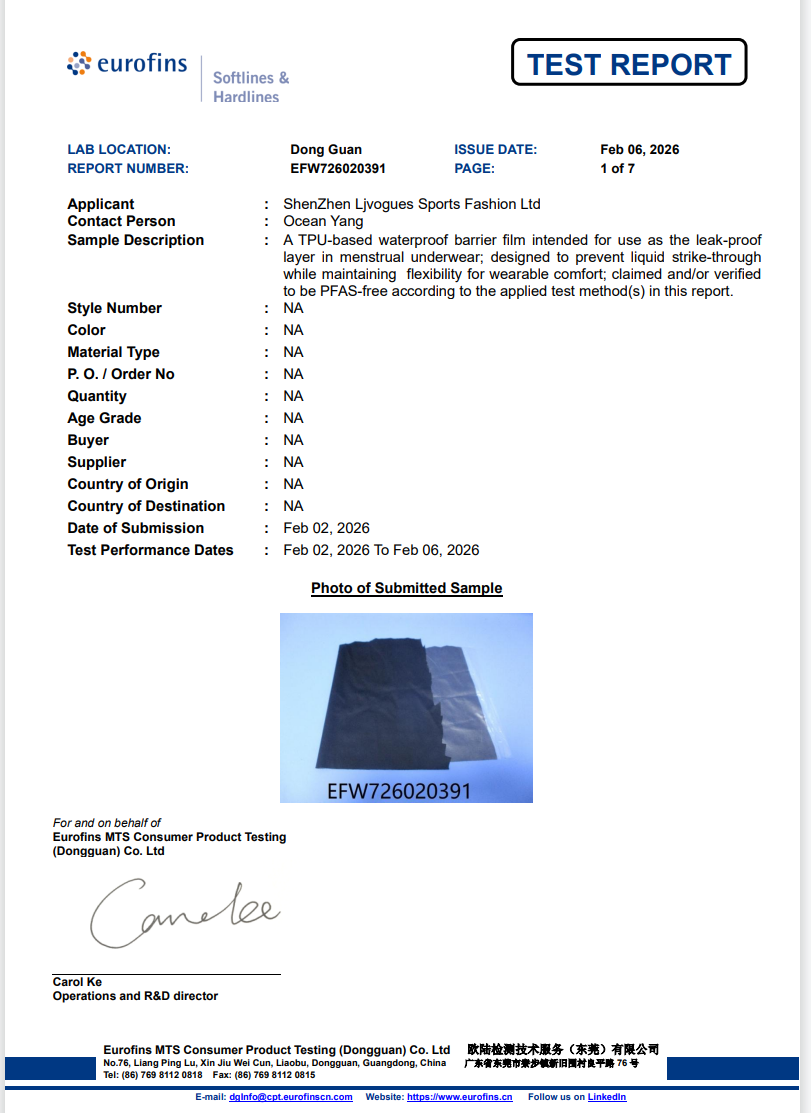
A period underwear manufacturer controls quality by checking materials before cutting, controlling gusset construction during sewing, testing absorbency and leak resistance, measuring finished garments, and reviewing production lots before shipment. A practical factory program may hold fabric weight within about ±5%, measure several pieces per size during sewing, test wash durability over repeated cycles, and inspect final orders under an ISO 2859-1 sampling plan. Underwear also falls within OEKO-TEX® STANDARD 100 Product Class 2 because it has direct skin contact. Appearance inspection alone is not enough: liquid handling, waterproof-layer integrity, fit, and wash stability all need measurable acceptance limits.
Quality starts with incoming fabric because sewing cannot correct a membrane with pinholes or an absorbent textile that varies substantially from roll to roll. A factory normally records supplier, roll number, dye lot, width, fabric weight, color, stretch, recovery, surface condition, and shrinkage before releasing material to cutting. A useful production tolerance for fabric weight is around ±5% when that range is agreed in the specification; a 200 GSM fabric, for example, would then be controlled between roughly 190 and 210 GSM.
The body fabric is only one part of the product. A typical menstrual brief may combine a skin-contact wicking textile, one or more absorption layers, a liquid-resistant membrane, shell fabric, elastic, sewing thread, and labels. A four-layer gusset can therefore fail even when 75% of its components are acceptable: one incorrectly oriented membrane or poorly recovering elastic can make the complete garment unusable.
Material inspection should therefore follow individual component specifications rather than a single “fabric passed” record. Lot numbers matter because a problem found after shipment can then be narrowed to one fabric roll, lamination batch, or elastic delivery instead of an entire purchase order.
Absorption also needs a defined test method. A statement such as “holds 25 mL” has limited manufacturing use unless the factory controls sample size, liquid, application rate, conditioning, test area, and pass point. One industry manufacturing protocol uses 0.9% saline and specifies the rated liquid volume before leak-through; it also notes that performance at 37°C can differ by roughly 10–15% from room-temperature testing. Those figures are useful for showing why brands should approve a written method rather than compare numbers produced under unrelated conditions.
Capacity is not the only measurement. Liquid must enter the upper textile quickly enough, spread through the absorbent area, stay away from the skin-facing surface, and remain contained by the membrane. A 25 mL gusset that takes liquid slowly can behave differently from another 25 mL construction during wear. Rewet testing adds pressure after absorption and measures how much liquid transfers back to blotting material; one published manufacturing protocol uses at least 3 samples per batch for this type of check.
That laboratory-style testing leads naturally to construction control on the factory floor. Before bulk cutting, operators should work from the approved pattern revision, approved material list, size chart, gusset drawing, seam specification, and reference sample. If a buyer changes the back coverage of the waterproof panel from 180 mm to 210 mm, the revision must reach pattern making, cutting, sewing, and inspection before production continues.
Cut components then need separation by size, color, material lot, and production bundle. Stretch fabrics can move during spreading, while narrow gusset layers can shift more easily than large body panels. Factories commonly use notches, templates, positioning marks, or shaped fixtures to keep the absorption layers inside their specified area. A 5 mm placement error may look small on a table but can reduce protective coverage along a leg seam.
Sewing introduces another set of measurable variables. Machine type, needle specification, stitch class, stitch density, seam allowance, thread tension, and elastic extension should be set before line production. Inspectors can then check a small sample at regular intervals instead of discovering the same sewing defect in several thousand finished pieces.
A practical in-line record might check 5 garments after machine setup, another 5 after an operator change, and additional pieces at scheduled intervals. The exact sample plan varies by factory and order size, but the purpose is consistent: detect movement in measurements or workmanship while correction still affects a small quantity rather than an entire day’s output.
Needle selection deserves attention because period underwear often combines soft knitted fabric with laminated material. A damaged or unsuitable needle can leave larger perforations, skipped stitches, yarn damage, or marks around the waterproof area. Machine maintenance records and broken-needle procedures also help isolate affected bundles instead of allowing uncertain pieces to move into packing.
The gusset should be inspected as a functional assembly, not only as a sewing operation. The inspector needs to confirm layer order, front and back coverage, seam placement, membrane condition, thickness, symmetry, and the absence of folds between layers.
Wash performance comes next because reusable underwear is sold for repeated use rather than one wear. Development teams can compare dimensions, elastic recovery, seam appearance, delamination, absorbency, and leakage before and after a defined wash program. Even a 3% shrinkage change can matter when several materials in the same gusset shrink at different rates, because differential movement can produce puckering or shorten the protected area.
A garment measuring 72 cm around the relaxed waist before laundering, for example, would lose more than 2 cm if shrinkage reached 3%. That change may alter fit even when stitching remains intact. For that reason, factories should record separate measurements for waist, hip, front rise, back rise, leg opening, gusset width, and protected-panel length instead of using a single overall size measurement.
Color and chemical requirements also belong in production control. OEKO-TEX® STANDARD 100 places underwear in Product Class 2 for articles with direct skin contact, and the certification system tests textiles and accessories against more than 1,000 substances. OEKO-TEX® also states that its limits are reviewed at least annually, so a report from several years ago should not automatically be treated as current.
One recent change shows why the date matters. The 2025 OEKO-TEX® update reduced its BPA limit from 100 mg/kg to 10 mg/kg, with revised requirements taking effect on April 1, 2025. A manufacturer selling directly against current brand compliance specifications therefore needs to review certificates, test reports, applicable product class, certified article scope, and validity period rather than storing one old PDF indefinitely.
Physical color performance is also measurable. Published OEKO-TEX® requirements for direct-skin-contact textiles have included minimum staining grades for water, acidic perspiration, alkaline perspiration, and dry rubbing. A factory should therefore keep approved lab dips and production shade references under controlled lighting, especially when one order uses several dye lots. Mixing two visually different lots in the same retail carton can create a complaint even when garment construction is correct.
For brands working with Ljvogues or another period underwear supplier, production records are more useful when they connect material inspection to finished-carton release. One garment identification record can reference the purchase order, fabric lot, waterproof-material lot, cutting bundle, sewing line, inspection date, test record, packing batch, and carton number. A complaint involving 20 pieces can then be compared against the affected production batch rather than all units produced that season.
Final inspection should also separate functional failures from ordinary appearance defects. ISO 2859-1 sampling is widely used in consumer-goods inspection, while commercial apparel programs often specify different AQL limits for major and minor defects. One published period-underwear QC example uses General Inspection Level II with AQL 2.5 for major defects and 4.0 for minor defects, while treating critical defects separately. Those numbers are an example specification rather than a universal requirement.
| Inspection area | Typical production record | Example measurable check |
|---|---|---|
| Body and gusset fabrics | Supplier, roll and dye lot | Fabric weight around agreed tolerance, such as ±5% |
| Absorbent assembly | Material code and layer order | Rated liquid capacity, acquisition and rewet |
| Waterproof layer | Membrane or laminate lot | No leak-through under the approved test method |
| Sewing | Line, machine and operator record | Stitching, seam allowance and gusset alignment |
| Fit | Size measurement sheet | Waist, hip, rise, leg opening and gusset dimensions |
| Laundering | Wash-test record | Shrinkage, recovery, delamination and leakage after washing |
| Final shipment | Carton and inspection report | ISO 2859-1 or buyer-approved sampling plan |
AATCC also emphasizes using the current version of referenced textile test methods, specified equipment, calibration controls, correct specimen orientation, and limited sample handling. Its proficiency programs cover areas including moisture management, colorfastness, physical properties, antibacterial performance, and resistance testing, with participating laboratories comparing results across a large testing population. A factory claiming an AATCC-based result should therefore identify the actual method rather than writing only “AATCC passed” on a report.
Production teams can then use defect records to decide when material or process review is needed. If 8 of 200 inspected pieces show the same gusset-position problem, repairing eight garments addresses the immediate pieces but does not explain why a 4% defect rate appeared. The factory should check the positioning template, operator method, pattern markings, cut-part dimensions, and machine handling before the next production batch enters the same operation.
Supplier changes need the same discipline. Replacing a 180 GSM absorbent fabric with a visually similar 180 GSM alternative does not prove equivalent liquid acquisition, rewet, shrinkage, hand feel, or wash performance. New fabric, membrane, adhesive, elastic, finishing treatment, or construction should be compared with the approved specification and tested again before bulk use, particularly when the product’s advertised capacity depends on that material.
Shipment release should happen only after quantity, size assortment, labeling, barcodes, care information, packing, workmanship, measurements, and required performance records have been reviewed. For a 10,000-piece order, checking only finished appearance gives no information about whether the absorbent layer came from the approved lot or whether the waterproof material passed its assigned test.
A stronger factory file connects incoming inspection, production measurements, test samples, non-conforming records, repairs, final inspection, and carton identification under the same purchase order. When a defect is reported months later, the manufacturer should be able to identify the material batch and production records behind that garment rather than rely on memory or visual comparison. That level of traceability makes production quality measurable across repeat orders, sizes, colors, and material revisions.